Call me a feminist, if you will, but I'm a traditional feminist. I hate the modern dualities of wanting to make women victims all the time, while simultaneously claiming women can do anything a man can do. Um... no. I believe that God created men and women to complement one another, and He did that by giving women different strengths than men.
Of course God didn't use a cookie cutter, so none of us are the same... just as individuals may be thin or plump, short or tall, athletic or brainy, etc. and so forth and so on, the strengths of men and women are also on a sliding scale, and perceptions can be altered by comparisons. The short 10-year-old child can still seem quite tall to even an unusually tall 5-year old. Likewise some women can outperform some men in areas where men are typically stronger, and vice versa with the man who is unusually strong in a more typical feminine strengths. All this to say that the following comparisons are AVERAGES, a word I will repeat often to emphasize this point. It does not mean that I or anyone else should believe for a moment that there can't be extraordinary exceptions. Human beings are nothing if not amazing in our diversity and uniqueness!
All that said, here are 3 observations I have personally made in my 50+ years of life...
1. The average man is stronger physically than the average woman.
This means he can lift, carry, push, and pull more. He is, as the saying goes, tougher than women.
However, the average woman appears to be stronger in a certain type of endurance.
This means that she can endure the pains of pregnancy and childbirth, most more than once, and also continually cope with the monthly mock labor pains and mess. She can also power through a cold or injury to continue caring for the children, and put up with unpleasant situations for a longer period of time. How many men do you know who are the primary diaper changers, or who care for sick children on a regular basis, or who volunteer to clean up the vomit and etc.? Exactly.
2. The average man is stronger in mechanical and spatial reasoning.
This is why so few women are carpenters, mechanics, engineers, pilots, and truck drivers. Of course there are exceptions, but these are the worlds of men, for the most part.
The average woman, on the other hand, is much stronger in compassion and nurturing.
This can be observed by a simple observation of all of the stay home parents, day care centers, elementary schools, and nursing homes (anywhere in the world!). The vast majority of child and elder caregivers are women. There are exceptional men who are gifted in this area, but most men do not have the type of strength it takes to care for young children or the bedridden on a day after day after day basis.
2. The average man is stronger in controlling his emotions.
We could argue that this has a cultural basis, and is learned, but if this is true it seems to be a universal cultural norm among all of humanity. Men have the emotions, of course, but are much less likely to "wear it on their sleeves," reacting with strong visible emotions.
However, the average woman is stronger in emotional stamina.
Perhaps this is due to the fact that women are so much more likely to express their emotions, so that they do not get bottled up inside, but the fact is that average women tend to "soldier on" through life much more than the men around her. This is particularly telling in suicide statistics. Some sources say that women will attempt suicide more than men, but the reason they fail is typically because they use less lethal methods, which is more of a cry for help than a serious attempt to kill oneself.
https://afsp.org/about-suicide/suicide-statistics/
These are my personal observations, as stated previously. Feel free to disagree, but I just felt like writing it out because I am sick and tired of women being portrayed as either hopelessly weak or just as capable of men in every area. No. While there are some exceptions, to be sure, the average woman is going to be much happier fulfilling roles that play to her strengths. (And obviously there are many many jobs that can be fulfilled equally well by either gender.) But we as a culture need to stop devaluing the extraordinary power of women.
Monday, September 24, 2018

Tuesday, February 13, 2018
Random Memories from my (public) Grade School Days
(some of which are quite different from today's schools!)

2. Kindergarten was half day only, with separate morning and afternoon classes (and a lunch break for the teachers in between). It met in a completely separate building from the actual Elementary School. There was no Kindergarten "graduation" to my knowledge, but when I was K age, the teachers were on strike and it was cancelled for the entire year.... so I never went anyway.
3. Kids learned to read in 1st grade. Those who could already read were simply given more challenging material or books, but it was not at all expected that kids knew more than letter recognition before they started.
4. Recess was twice per day through at least 2nd or 3rd grade. (I honestly don't recall when that ended.) We had a recess break of 15-20 minutes in the morning, then another half hour break immediately after lunch. It is possible that some kids were kept in for recess on occasion, but if so I don't remember that. What I remember is everyone going outside.
5. Speaking of outside, my school had its own "nature trail" in the woods behind the school. There was a clearing at more-or-less the halfway point with benches. We went on the trail with our class for science lessons every once in awhile, and sometimes for fun times too.
6. We had a snack break every morning in 1st grade (and I believe maybe 2nd?), which was in the cafeteria with those little cartons of milk available for every student. I don't remember having any kind of snack break in 3rd grade and up, though it's possible I just don't remember.
7. School met from 8:30 (or possibly 8:20?) until 3:00, for all grades all the way through high school.
 8. All of the teachers and the principal had wooden paddles, and yes, they used them when they felt it was appropriate. The vast majority of us thought nothing of it, other than the deep desire to NOT get in trouble and actually be paddled. I believe that stopped when I was in 5th or 6th grade. Most teachers used their paddles very rarely, and a few didn't use them at all, but they all displayed them so we knew it was an option. Standing in the corner was probably the most common punishment.
9. We had "hunter safety" (which of course included gun safety) training in 5th or 6th grade for ALL students. I seem to remember shooting rifles at targets also, as part of this.
10. All students 1st through 12th rode the same bus (unless of course they drove or got rides). Most of the teens were kind to the elementary students, and would help them if they were scared or hurt.
11. Day care was unheard of, though there were after-school clubs and programs. Some kids also would get off the bus at different stops, or ride a different bus in the afternoon in order to reach a Grandma or other caregiver's home.
12. Probably 90-95% of us had full time "stay home" moms at home, yet it was pretty rare to see a mom at the school (unless she worked there, of course). We didn't have such things as "class mom" or a group of volunteers coming in every day. Most parent volunteers only came for special events or after school things.
 13. Speaking of special events, holidays were kind of a big deal, and we celebrated most of them. Elementary students not only dressed up for Halloween, but we had a parade up and down the main street of the little town, and the townspeople would come out to cheer for us. Valentine's Day always was a party, but giving out valentines was optional (and yes, it was actually pretty hard on those who didn't get very many--no mandatory giving to everyone in the class back then). We also celebrated May Day in the spring, complete with Maypole dancing outside.
14. My elementary school went all the way through 6th grade, though granted my class was the very last one to experience this. The first Middle School (5th through 8th) was established there when I was in 7th grade.
15. We had horrible ugly uniforms we were required to wear for Gym Class (today called P.E.) in 7th and 8th grade. Thankfully those went away in high school, and we got to go cross-country skiing in the winter instead (so our uniforms were parkas and ski pants then!).
16. My high school was in the middle of farm country, and there was literally nothing but fields, cows, and a few houses for miles around. We didn't have special days where Seniors could go out for lunch, because there was nowhere to go! I don't remember how long lunch was, but I do remember it was pretty relaxed, and we had plenty of time to talk... probably half an hour? It was longer in middle school, because we were permitted to go outside when we were done eating--essentially a recess break, though most of us just sat around talking with our friends.
17. My high school had Selectric typewriters, with the letter balls (anyone else remember those?), and a couple of older ones with the slide bar you had to push back after every line. The school got ONE computer my senior year, and only the Calculus students were allowed to use it! It was kept locked up in a closet of one of the math rooms. I didn't learn to use any sort of word processor until after high school, at a special 4-5 month secretary training program that same year I graduated (1983)--and even there it was free-standing word processing machines which did nothing else. My four years of typing in high school were all about typing speed and accuracy. I also learned shorthand in high school, which I've forgotten all except the curve that meant "the" LOL. My first job out of high school (which I did part time during my secretary training class), I had a boss who would dictate onto mini-cassettes, and then I would type directly from the dictation (with only occasional stops and backing up, if I didn't quite understand what he said). My highest typing speed was 98 words per minute.
Tuesday, June 20, 2017
Why I don't like the term "Worship Leader"
Someone asked me the other day WHY it bugs me when people today call the Music Director the "Worship Leader." They didn't call it that before, but isn't it normal and natural for language to evolve and change over time? Well, yes, this is true... but at the same time...


1. As a logophile (lover of words), we hates it (said in my very best whiny Gollum voice, LOL)! Yes, words change. That doesn't mean I have to like it. ;)
2. It's not very descriptive. Truly, the first time I heard the term I thought it was a new name for the assistant pastor or head of the elder board or something--I envisioned someone who was in charge of coordinating all the 101 different ways to worship within a church to ensure we were all on the same "theme" or focus or something. I was frankly shocked when I finally understood that this was just a new title for the Director of Music, and that people were further changing the meaning of the word "worship" to simply mean "music" (in a church). This is the explanation I have most often given for my pet peeve about this, but I realized the other day that...
3. The music is not really worship at all anymore, at least not for me. :( And I think that's why it bugs me most. Right about the time I started hearing people calling music "worship" and titling the music director as "worship leader" was the same time many churches apparently gave up on the whole idea of congregational singing. Most of the music is loud, repetitive, and shallow (theologically), and it's often completely inappropriate for congregational singing and/or totally unfamiliar (because I don't listen to Christian pop radio). I'm OK with some of the music being this way, because children and young adults SHOULD feel like the very important part of the church that they really are! And we absolutely should have some of the music they prefer at every service. :) But does it have to be ALL of it? Are older adults no longer an important part of the church?? Is there truly no value to passing on to the next generation the classic "hymns of the Faith" that have been around for hundreds of years? :'( I remember as a kid feeling such pride and a sense of belonging when I would master one of the old hymns, envisioning congregations singing it all over the world for hundreds of years... This whole "worship leader" thing is mostly just a minor pet peeve of mine, but that lost tradition truly makes me sad. And seriously, music leaders, do you really not see it as a problem if/when a large portion of your congregation is leaving the service wondering "Does it still count as worship when I am excluded from it?"
Monday, July 25, 2016
10 LOW-cost Suggestions to Prep your Home for Sale
 No, I have never worked professionally in Real Estate. However, in the last 6 years I have sold a house, plus been house-hunting for my family 6 different times--7 if you count hunting for a new apartment with my eldest son! With various real estate agents I have toured more than 2 dozen houses in 2 different States. And I've seen some things that have proven to me that while some of these things may seem like common sense, they evidently are NOT so common!! I've also had the privilege of working with one Realtor who is amazing, and yes some of the following comes from her (thank you, Tracy Hoyt in Valrico, Florida!!). :) So, if you are getting ready to sell your house, and actually reading my obscure little blog, here is some free amateur advice of basic and inexpensive prep work (because we well know that not everyone can afford to do major upgrades and updates). Little things really can make a big difference, because when you are selling a home, first impressions matter.
1. Remove as much clutter and personal items as possible. You are getting ready to move anyway, right? So, pack that stuff away. Two or three family photos here and there makes the house look like a home, and not a model or a hotel, so don't remove every single one. But having strange faces staring at you from every wall is a little disconcerting when you are walking through a potential new home, and those walls completely covered with photos have GOT to go. Potential buyers want to see the actual wall, and I know whenever I saw walls overwhelmed with stuff I wondered just what problems all those frames may be hiding. Cost: $0
 2. Don't feel like you have to repaint the whole house, unless you have color or pattern choices so unusual they may make the average buyer balk (as pictured, though this particular photo is from the web, not from a house I saw personally). I still remember the house we toured with one bedroom painted entirely black. Yes, that was a bit much--it was hard to see the room, even with the lights on. Most other colors, as long as they look nice, may be OK. What is more important is CLEAN walls that do not have any obvious damage. So do patch the holes for any excess decor you remove (in #1), and take the time to do some touch-up here and there to make sure your walls look fresh and clean. I've seen walls in homes for sale with obvious dirt and cobwebs. Yuck. If you have the time and money, consider doing some touch-up of the baseboards and ceiling edges also--those paint splatters are more noticeable than you think to some buyers! Cost: $0 if you have extra leftover paint on hand, minimal if you need to purchase small cans for touch-up.
 3. Speaking of cleaning, don't forget the yard and any smells. Have a friend who doesn't visit often walk in and sniff, because honestly you might not even notice if you live there all the time (especially pet odors). This is especially important if you have to vacate the house before it sells--I've seen vacant houses with overgrown yards that reeked of pet odor or some other smell (made worse, no doubt, by sitting vacant with the a/c off and the heat deepening the odor). I have had one or two houses that I walked out of without even seeing the whole thing, because it smelled THAT bad to me. Yes, this one may cost you something if you have to leave the house empty and are unable to go yourself each week to clean it and mow the yard, but you may be able to save some $$ by hiring a reliable local teen or college student. Cost: Will vary
4. While you have that friend over to check the smell, ask him or her to walk around your house and look for other out-of-the-ordinary or too-personal things that may put off a buyer. I looked at one house that had a child's name painted large and bold on his wall. Many house hunters want to be able to move in immediately, painting later, and something like that could easily put them off. Different colors are fine. Large murals or personal things? Probably not. The most unusual personal item I saw when house-hunting was a large and clearly labeled grave in the back yard, most likely for a pet (because the marker held a single name). Now I have buried a cat in a yard before, and I understand the desire to want to remember that beloved pet and even mark the grave in some way. But mark it with a bush, a tree, or even a plain but decorative rock. Please don't ask a stranger to buy your house with a memorial to your pet still there. Cost: Will vary, according to what you need removed and what you may need to do to fix it.

5. Do any routine maintenance you have been putting off. HVAC (heating and air conditioning) systems in particular should be routinely serviced every year. Outdoor wooden features (deck, swing, etc.) should be resealed each year, especially in damp climates. Many people don't seem to know this, or fail to keep up with it during years of renting the home. But those years of neglect are almost guaranteed to cause damage that will show up on the home inspection for any potential buyer. Save yourself some frustration and cost in the final days (or worse, a lost sale!) by looking over these things and doing necessary repairs in advance. Check over plumbing and appliances remaining also. Defrost that freezer, and clean out that dryer vent, etc. Cost: Depends on whether you kept up with routine maintenance in the years you owned the home. If you have, then very little!
6. Check the electrical outlets and light switches. It's best if all of them in a single room match, at least, if not all of them throughout the house. This is especially true if you will be showing the house after it is vacant, because then those mis-matched covers are REALLY noticeable, and they tend to look haphazard and unfinished. If you must, replace them all with white--those are often priced at about 50c each, so cost will be minimal. And don't forget to make all the screw heads point the same direction. (Really! This is something I would never even notice, but my husband did, and he worries that all the electrical work must be "sloppy" if this simple thing isn't done.) Cost: minimal
7. Clean the windows and sills, and make sure every one has some sort of dressing for showings. Simple white rods are very inexpensive; there is no need to spend a lot. If you have basic sewing skills, you can make curtains from old clothing, sheets, or towels, or you can purchase used ones quite cheaply at thrift stores and yard sales. Yes, I do understand this is partly a style preference, and some people prefer naked windows. However, I know I'm not the only one who feels that it just makes it look more finished, and if you ever have to leave the house vacant this has the advantage of making the house look occupied from the street (discouraging vandals or squatters). Cost: minimal
 8. Check the kitchen cabinets (and any other cabinets) and doors for loose hinges, drawers that don't close quite right, etc. This is another thing which may be overlooked, but some buyers are more thorough than others, and having loose doors or knobs and wonky drawers makes a house seem worn out and not cared for at all. It especially looks bad if the drawer is hanging off. Cost: Little or nothing (possibly replacing a screw or something)
9. Take the time and expense to spray the house for bugs, and clean out the light fixtures of dead bugs (and other dust). Nothing says dirty and not cared for like seeing live bugs crawing around, or turning on an overhead light with a shade filled with dead bugs. Ew. Cost: In this area it is anywhere from $50 to $150 for a one-time visit from a professional exterminator, and you could easily save money by doing this yourself.
10. If you can afford it, and haven't recently done so anyway, add some nice permanent item that makes the house look more like a home, that has been occupied by people who really care about it--something that will stay with the house, like a bonus. You could put a nice little bird feeder in the yard. You could add a storage cabinet in the garage, or some nice built-in shelving. You could add a nice little flower garden in a corner of the yard. You may not be able to afford to do a BIG thing like remodel a bathroom or put in a new patio, but you can still do a little thing that people will notice and appreciate, something that will make people think about themselves living in that house and enjoying watching the birds or smelling the flowers, etc. Be creative! You can't change the location or the footprint of the house, but you can make it look like an appealing and well-loved home! Temporary "staging" things are good too, of course, but permanent things are more likely to be the things they talk about. I remember talking about the house with the patio tent, the house with the bird feeder, the house with the built-in cabinets in the garage, etc. Those are the little niceties that make it memorable. Cost: will vary according to what you decide to do.

Wednesday, April 6, 2016
Why I believe Mom care is best
Let me preface this by saying that this is NOT meant to be a criticism of moms who work outside the home. Being a working mom is HARD, and too often the working moms *still* are expected to fulfill all of the "traditional" duties of wife and mother. But perhaps because so many working moms are managing to hold it together (barely) and making it work, the moms who make the choice to stay home for their children are getting slammed even more, their contributions being devalued entirely too much. It's high time we acknowledge that some choices are just BEST for children, even when they don't work for us personally. A good example is breastfeeding--yes, it really is best!! I didn't do it; and while I can explain my choice, my reasons won't change the fact that IF at all possible it really truly is the best choice! Thankfully, formula today is amazing, and works well as a good 2nd choice. Day care can be an acceptable 2nd choice also, if that is what you need (or just want) to do, and there are well-run day care places where your children will be just fine. But I wanted to write out this comparison list just to illustrate both
the genuine value and worth of a "stay-home" or "full time" mom, and explain why I believe that Mom care still is and always will be best.
Just for comparison, I'll take it from the perspective of a working parent seeking out a Day Care/Preschool for small children. And what does everyone want?
1. First thing people look for in Day Care is the best possible teacher:child ratio. The fewer children per teacher the better. Day Cares and Preschools with ratios of 4 to one or less are highly prized (and usually MUCH more expensive!). Yet oddly, moms who stay home to care for their own children are often given even more criticism if they stay home with "only" one or two children. Moms of three or four small children are more likely to be "forgiven" for the choice to raise their own children, simply due to the unaffordability of placing that many children with someone else all day. Yet instead of our modern culture praising the woman who is willing to devote herself to her children, too often we hear demands for day care subsidies or criticisms of families for having "too many" children. :(
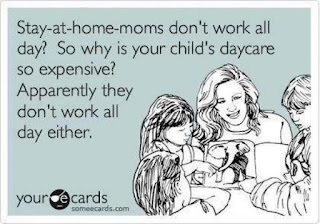
2. Next thing people look for in a Preschool or Day Care is workers who devote themselves almost entirely to the children. They don't want their care-givers to have their attention split by having to do laundry and clean, etc. (other than spot cleaning, of course)--they want to see completely devoted "teachers" spending every moment with the infant or small child! And almost every day care and preschool will hire separate janitors, cooks, administrators, assistants, and substitutes! Think about that for a moment, and ask yourself why the most common question "stay home" moms get is "what do you do all day?" Do you ask your children's day care/preschool teacher at the end of each day the same question?
 3. Another thing parents look for is low turnover. This is remarkably hard to find in the real world. Most day cares and preschools pay very poorly, and thus have extremely high rates of staff turnover. They also tend to treat even the youngest children like school-age children, moving them to a completely different classroom and "teacher" each and every year, and rarely if ever mingling one age group with another. Obviously this is a non-issue with a mom caring for her own children (other than the fact that she never gets a sick day!). The consistency of care can't be beat!!
4. Another big question is cost. This is where the value of mom care gets a little less clear, because obviously the biggest reason many women choose to continue working outside the home is income. However, for many women of more than a single child, day care costs can come very close to their actual income, and often go over it if you include ALL of the expense of working. This includes commuting costs in gas or public transportation, having separate "work clothes," buying lunches for work, possibly being pushed into a higher tax bracket or needing another vehicle, having to go to the doctor for every little thing because day cares can't even put on diaper rash cream without a doctor's note these days... and etc. Some moms who are on the fence decide to stay home after doing the math and discovering that they are making $1 per hour or less after all the expenses add up! Granted you might be able to find a cheaper day care to help that expense, but unless it is family care do you really want to cut corners on your child's care? NO ONE will ever care for your child more than you will.
5. Lastly, when looking for day care or preschool, parents want highly trained care givers. Well, Mom might not have that child CPR training, but that doesn't mean she can't get it! Mom might not have a degree in child development, but really? For thousands of years, moms managed to raise children without fancy pieces of paper from modern "experts." No amount of education can replace the love and care of a devoted Mother.
 So, does this make the choice easy? Probably not. Sometimes there is no real choice, especially if mom is the sole provider for the family. Moms who choose to keep a job will reap the rewards of income and adult interaction, paid sick days and hopefully at least an occasional lunch break, benefits such as health insurance and/or retirement savings... but in most cases mom will still be expected to cook and clean and of course "love on" her children as much as she can when she is home. A working mom will have to juggle schedules with her husband, fighting over who has to take time off when a child is sick, or a necessary service worker is coming to the house (cable, electric, etc.), or daytime errands need to be run. Working moms will worry about their kids all day long, stress about whether the day care is doing the best job they can, and they often face criticism from family or friends who made the opposite choice. If they choose to stay home, they will forever have "only" or "just" shoved ungraciously in front of their chosen profession (of being a Mother). There will be no Christmas bonus, no awards or accolades, and of course no paycheck (unless she tries to work from home, which is a whole 'nother issue!!). Unless the family is lucky enough to live close to Grandma, mom will likely almost never have a break.
But the best rewards are your children themselves, because as a "stay home" mom you will have to miss nothing. And just like the breastfeeding mom, even at your most exhausted and frustrated you can rest in the assurance that you are making what is truly the BEST choice for your children! And if it stops working for you, you can always make the second-best choice, and that choice still very often works out just fine--near as I can tell, my kids have no significant "damage" from being fed formula. :) Most day-care kids turn out just fine also. Some are even lucky enough to have Grandma (or other family member) care, which is a beautiful thing!
Believing mom care is the best choice doesn't mean we have to slam those who made "second choices." Offer them sympathy and support, as any fellow mom. Parenting is HARD. I can say that I chose to formula feed and still enthusiastically applaud those who chose to breastfeed. And I can proudly say that I did choose to stay home, even to the point of homeschooling for several years, without insulting working moms. I do sometimes regret that I didn't breastfeed. Sometimes. But I don't regret staying home with my children, not even a little. I hope whatever choices you make, you will continue to be satisfied with them. The only choice that really matters is that you LOVE and care for your children the best you can!

Just for comparison, I'll take it from the perspective of a working parent seeking out a Day Care/Preschool for small children. And what does everyone want?
1. First thing people look for in Day Care is the best possible teacher:child ratio. The fewer children per teacher the better. Day Cares and Preschools with ratios of 4 to one or less are highly prized (and usually MUCH more expensive!). Yet oddly, moms who stay home to care for their own children are often given even more criticism if they stay home with "only" one or two children. Moms of three or four small children are more likely to be "forgiven" for the choice to raise their own children, simply due to the unaffordability of placing that many children with someone else all day. Yet instead of our modern culture praising the woman who is willing to devote herself to her children, too often we hear demands for day care subsidies or criticisms of families for having "too many" children. :(

2. Next thing people look for in a Preschool or Day Care is workers who devote themselves almost entirely to the children. They don't want their care-givers to have their attention split by having to do laundry and clean, etc. (other than spot cleaning, of course)--they want to see completely devoted "teachers" spending every moment with the infant or small child! And almost every day care and preschool will hire separate janitors, cooks, administrators, assistants, and substitutes! Think about that for a moment, and ask yourself why the most common question "stay home" moms get is "what do you do all day?" Do you ask your children's day care/preschool teacher at the end of each day the same question?

4. Another big question is cost. This is where the value of mom care gets a little less clear, because obviously the biggest reason many women choose to continue working outside the home is income. However, for many women of more than a single child, day care costs can come very close to their actual income, and often go over it if you include ALL of the expense of working. This includes commuting costs in gas or public transportation, having separate "work clothes," buying lunches for work, possibly being pushed into a higher tax bracket or needing another vehicle, having to go to the doctor for every little thing because day cares can't even put on diaper rash cream without a doctor's note these days... and etc. Some moms who are on the fence decide to stay home after doing the math and discovering that they are making $1 per hour or less after all the expenses add up! Granted you might be able to find a cheaper day care to help that expense, but unless it is family care do you really want to cut corners on your child's care? NO ONE will ever care for your child more than you will.
5. Lastly, when looking for day care or preschool, parents want highly trained care givers. Well, Mom might not have that child CPR training, but that doesn't mean she can't get it! Mom might not have a degree in child development, but really? For thousands of years, moms managed to raise children without fancy pieces of paper from modern "experts." No amount of education can replace the love and care of a devoted Mother.
 So, does this make the choice easy? Probably not. Sometimes there is no real choice, especially if mom is the sole provider for the family. Moms who choose to keep a job will reap the rewards of income and adult interaction, paid sick days and hopefully at least an occasional lunch break, benefits such as health insurance and/or retirement savings... but in most cases mom will still be expected to cook and clean and of course "love on" her children as much as she can when she is home. A working mom will have to juggle schedules with her husband, fighting over who has to take time off when a child is sick, or a necessary service worker is coming to the house (cable, electric, etc.), or daytime errands need to be run. Working moms will worry about their kids all day long, stress about whether the day care is doing the best job they can, and they often face criticism from family or friends who made the opposite choice. If they choose to stay home, they will forever have "only" or "just" shoved ungraciously in front of their chosen profession (of being a Mother). There will be no Christmas bonus, no awards or accolades, and of course no paycheck (unless she tries to work from home, which is a whole 'nother issue!!). Unless the family is lucky enough to live close to Grandma, mom will likely almost never have a break.
But the best rewards are your children themselves, because as a "stay home" mom you will have to miss nothing. And just like the breastfeeding mom, even at your most exhausted and frustrated you can rest in the assurance that you are making what is truly the BEST choice for your children! And if it stops working for you, you can always make the second-best choice, and that choice still very often works out just fine--near as I can tell, my kids have no significant "damage" from being fed formula. :) Most day-care kids turn out just fine also. Some are even lucky enough to have Grandma (or other family member) care, which is a beautiful thing!
Believing mom care is the best choice doesn't mean we have to slam those who made "second choices." Offer them sympathy and support, as any fellow mom. Parenting is HARD. I can say that I chose to formula feed and still enthusiastically applaud those who chose to breastfeed. And I can proudly say that I did choose to stay home, even to the point of homeschooling for several years, without insulting working moms. I do sometimes regret that I didn't breastfeed. Sometimes. But I don't regret staying home with my children, not even a little. I hope whatever choices you make, you will continue to be satisfied with them. The only choice that really matters is that you LOVE and care for your children the best you can!

Monday, February 1, 2016
Five Stages of Moving to a New Area
Your experience may differ somewhat, as we all cope with things in different ways, and each stage has been a bit different for me too depending on the location, the age of my children, etc. But I have learned through the years that for me every major move inevitably follows this pattern, so I thought I'd share, in case someday someone reads this who might find help and encouragement knowing that what they are feeling is "normal," and especially that the hard stage(s) will pass, in time. Please note that when I specify "new area" I'm talking about moving at least several HOURS away from your former home. I really didn't experience most of these the couple of times I moved across town within the same area.
1. Anticipation and Planning
 This stage begins when you know the move is coming, and ends whenever stage 2 begins--sometimes very soon after getting your Orders (or transfer papers, etc.), but sometimes lasting months if you are fortunate enough to get a lot of advance notice. The anticipation may be something closer to dread, if you fear you may be moving somewhere you won't like, or you really love the place you live now. You may want to make sure your pets' vaccinations are up to date, or check your children's educational records, but most of what happens in this stage is research, and starting to plot out (sometimes on paper) how you will get everything done. Sometimes parts of this stage will repeat, if you research one place then get sent somewhere else! Good or bad, you will be filled with a sense of anticipation as you try to get a bit of an idea of what it will be like to live in this completely new
place!
Personal example: When we left Germany, we were hoping for an assignment in England. We made sure our cats had the necessary vet work, and I researched the area and other requirements... then we were told no, it would be Arizona or Florida, so we started the research all over again! Once the "hard copy" orders came at last, we started gathering information on weight allowances and making lists of what we would take to Florida, and what we would have to leave behind.
 2. Work, Stress, Work, Farewells, and Work!
This stage begins with boxes, as the time to plan has passed and the time for packing begins! Besides packing, you are working with all the various necessary places to find out what you need to do to transfer or carry necessary records with you, working on selling or clearing your current housing, arranging for movers or a rental truck, finding out where you will live when you first arrive at your new home, etc. etc. and etc.! In between all of the work, and living in a house filled with growing piles of boxes, you still have your daily things that need to be done, and farewells to be made to all of your friends and associations in what will soon become your former home! There really is very little time to feel much of anything in this stage but a general sense of overwhelming stress, as the final date looms ever closer!! Try to find time, if you can, to make one last visit to your favorite places (parks, restaurants, stores, etc.). You will be glad you did later.
Personal note: If your move will be international, expect the stress to be at least 100x higher than a domestic move!! And if you are military and your spouse is deployed to a hazardous area while you are doing most of the move alone, make that about 1,000x higher stress.
 3. More Stress, Work, and Discoveries
This stage begins with the arrival at your new home. If they didn't come with you, soon the boxes will arrive, oh boy! Now you have to find places for all the stuff you packed in stage 2! Of course half the pictures from the old house won't fit the walls of the new house (wrong color, wrong size, wrong something). If you kept curtains, maybe you will find some that fit, but inevitably some will be packed into storage for "maybe the next house." Every.single.move. it seems like something gets unpacked that leaves you scratching your head wondering why on earth you brought that, and something else gets left behind that you wish you'd kept! As you are unpacking, you are also completing the long checklist of changing your address with everyone, getting new driver's licenses, re-tagging the cars, trying to find where things are in the area, etc. And of course as you hunt for things you are also taking some time to explore your new home area. That part can actually be fun, as you discover a great new (to you) restaurant, a nice park, or a fun store in your new home town. Maybe if you are lucky you will even meet a potential new friend in your first few weeks and months. :) The stress will likely overwhelm most other feelings at this stage also, as there is just SO much work to be done!!
Personal note: For me one of the hardest parts of step 3 is starting the hunt for a new church home. Sometimes I feel like an abandoned dog seeking adoption by a new family! There have been a couple of moves where we were lucky enough to find a new church home in only a month or two, but sometimes it seems to take much longer.
 4. Nostalgia and Depression
This stage begins at different times during different moves, but basically it's what happens when all those emotions you have been keeping at bay with so much stress and work catch up to you. For some it may even overlap stage 3 or even stage 2. Suddenly you *hate* the place where you just moved, and the place where you came from seems like Utopia. You may sound like Phoebe of "The Magic School Bus" in this stage ("at my old school..."). Yes, this even happens during moves you were thrilled about when they first started. Now that you are gone, you will have those classic "misty water-colored memories" of the way things were, and they may come pouring down your face when you least expect it. My advice is to let it happen. That place you left is gone, and grieving is all a normal part of the process. The more you fight it, the more you will delay stage 5, and stage 5 is where you really want to be.
Personal note: Rather than share a personal story of depression, I want to share here the photo credit for the amazing shot I found for this section, which says it in visual form so much better than I ever could with words. Thank you, Georgie Pauwels (Flickr).
5. Finding Equilibrium
This stage begins when you start to truly feel like you belong in the new place. There isn't any timeline for it, unfortunately, but one day you will just wake up to realize you aren't depressed anymore. You might think about where you came from and be glad you are HERE instead of there. You will stop thinking of yourself as a "newbie." You will have found some sort of social group, or a (local) personal friend. At last you have balance, and you are home once again.

Personal note: If your family is military, or in some other career that makes you get used to moving, you may reach a point in this stage where you start to feel "off balance" again, and ready for the next move. For me that usually happens somewhere between 3 and 4 years at the same place. It's almost a repeat of stage 4, but on a much smaller scale--I don't get depressed the second time, just restless and a little discontented. For me it kind of came in waves (leaving stage 5, coming back to it, leaving again). It will be interesting to see how many times I go through this as a newly civilian spouse, now that my husband has retired from the military and likely won't be moving again anytime soon!
Tuesday, January 26, 2016
Seven Hazards of being a Former Military Spouse

2. You experience "re-entry" issues dealing with the civilian world. Not every spouse experiences this, of course--especially those who never lived on Base and never went overseas. But the military community has its own systems and ways of doing things, and just as we adjusted when we first "married the military," there are often adjustments back... especially if you have been "in" or overseas for so long that the way some things are done have changed in your absence! (And if you aren't dealing with it for yourself, you may well be dealing with it through your children!)

3. You seriously have to restrain yourself giving the smack-down to disrespectful people during the pledge of allegiance, National Anthem, etc. Or maybe you don't. ;) These people just don't get it.
4. You have high expectations for civilian life. You may think your spouse will be home all the time and life will be grand. You may think there will always be regular hours, no weekends, and so on. But civilian jobs can have overtime and business trips too. And if there aren't trips, adjusting to being home every night can also be more difficult than you might expect, after many years of getting used to your spouse being gone frequently. This speaks to "re-entry" (above), of course, but what I'm talking about here specifically is expectation vs. reality. Many former military have such high hopes for civilian life, and it doesn't always work out the way they envision. A friend once told me she knew of several divorces primarily caused by such unrealistic expectations. (There may have been other underlying issues too, obviously, but the transition to civilian life was the catalyst.)

5. Speaking of expectations, a big one talked about a lot among military folks is the idea that when you become a civilian you will make much more money. This is often not true, especially during the first few years. Many civilian jobs will start you as something resembling "entry level," in spite of your years of military experience. You may have been receiving tax breaks or discounts in utilities, etc. that you will no longer receive. There will be greater costs in medical--yes, even if you choose Tricare Prime (the retiree version has co-pays, as well as an annual fee). And it's highly likely that you will have to move in order to obtain a decent job. The military will move you one last time, if you can line up that job before you retire, but as we all know the military doesn't cover everything--there are always, always additional expenses associated with moving. Hopefully it won't be more than a few years before you are back up to what you were making before you "got out," if not more, but the transition can be harder than you think, especially if you didn't expect it (see #4!).
6. Remember those 30 days of annual leave? Granted, you weren't likely to take advantage of them every year, but when you were able to it was awesome! You also say goodbye to federal holidays, family days, and wing goal days (or your branch of the military equivalent--those were the terms in the Air Force). Again, even if you didn't get them often due to deployments, TDYs, or essential duty, sometimes you did. As a civilian, you won't. We all know we are giving those up when we leave the military, but knowing doesn't make it any less hard.


7. Don't be surprised if you tear up at things that never used to bother you before--seeing the type of plane fly by on which your husband (or wife) used to fly, hearing Taps, seeing a unit march by in uniform in a parade, etc. No matter if you don't really miss your military life, it was your LIFE, and it stays under your skin. :)
Friday, October 23, 2015
Five Envies/Joys of My Life "Married to the Military"
A new twist on the "Five Hazards of..." that I've been doing lately. I feel that a bit of envy is inevitable on these, but the hazard is whether you focus on the envy or can shift quickly to the joyful alternatives!
 1. As an enlisted wife, I often envied the officer wives for their social clubs, not to mention their access to the physical Officer's Clubs (which on most bases are much nicer than the Enlisted Club, if the base even has one). Then over time I realized they also moved WAY more often than we did. While I enjoy moving, having to move every 2 years (or more!) would be a Major pain (sorry, I couldn't resist the obvious pun!). There is joy in staying put a little longer, letting each place truly feel like HOME for a time.
2. As a deliberately unemployed military spouse, I sometimes envied those who were able to maintain a job or career as they followed their husband about. That second income meant they often had nicer things, more little luxuries, more travel, etc. Then over time I realized how priceless the time with my children is, and what a gift it was for them to have me always ALWAYS there for them, especially with dad's presence so hit or miss. (As a flyer, my husband worked odd hours, and some years was gone as much as 70% of the time, in erratic and completely unpredictable patterns.) It was definitely hard at times, and there is a long-term cost with that lack of employment experience for later jobs, but there is much joy knowing I was able to give them that stability in the face of such uncertainty.
 3. As a military dependent, I often envied my civilian counterparts who see the same doctor over many months or years, and really develop a relationship with him or her. Of course that doesn't always happen, even for civilians, but it's a lot more likely in the civilian "stay put" world. There were YEARS of military life where I never even saw the same doctor twice! Then again, military insurance and coverage is often recognized as THE best coverage there is, and it was the primary reason my husband enlisted in the first place. I don't know if joy is the right word, but it's definitely a huge comfort knowing that you wouldn't have the pain of a gigantic medical bill following the pain of trying to get an appointment, referral, and treatment for whatever your problem is.
 4. As a military parent, I often have envied the opportunities and stability of my friends' children who stay pretty much in the same place. We would find a great piano teacher or youth club, then move to a place where we'd have to start all over, and sometimes had a very hard time finding anything to replace what we had before. Moving so far away meant it could take months or years to find out about the opportunities in a new area. (Civilians are often surprised at how sad the advertising is for things in their area--they live there for so long they just KNOW about stuff through neighbors and long-time friends! We don't.) This was especially true living overseas--many things we just didn't have access to over there (such as community colleges for dual enrollment), and other things we could have done we didn't find out about until too late. But there is joy in all the places my kids have experienced. How many of their classmates, when they are studying World History, can say "Oh yes, Pearl Harbor? I've been there. Worms, where the trial of Martin Luther took place? Been there too."
5. As a recently retired military spouse, I sometimes envy those who have been able to stay in one place for the past 24 years, with a mortgage that is now close to being paid off!! But what a joy it has been to be able to experience so many different places! I wouldn't trade it for the world. :)
And all of these can be switched, of course, for those who are NOT military (or not enlisted, or not staying home to care for their children, etc.). That's the beauty of it--it pays to see a bit of both sides, and realize that we ALL have our own special joys and trials. There's no faster way to stop envy in its tracks, imho--stop counting their blessings and start counting your own.

 1. As an enlisted wife, I often envied the officer wives for their social clubs, not to mention their access to the physical Officer's Clubs (which on most bases are much nicer than the Enlisted Club, if the base even has one). Then over time I realized they also moved WAY more often than we did. While I enjoy moving, having to move every 2 years (or more!) would be a Major pain (sorry, I couldn't resist the obvious pun!). There is joy in staying put a little longer, letting each place truly feel like HOME for a time.
2. As a deliberately unemployed military spouse, I sometimes envied those who were able to maintain a job or career as they followed their husband about. That second income meant they often had nicer things, more little luxuries, more travel, etc. Then over time I realized how priceless the time with my children is, and what a gift it was for them to have me always ALWAYS there for them, especially with dad's presence so hit or miss. (As a flyer, my husband worked odd hours, and some years was gone as much as 70% of the time, in erratic and completely unpredictable patterns.) It was definitely hard at times, and there is a long-term cost with that lack of employment experience for later jobs, but there is much joy knowing I was able to give them that stability in the face of such uncertainty.
 3. As a military dependent, I often envied my civilian counterparts who see the same doctor over many months or years, and really develop a relationship with him or her. Of course that doesn't always happen, even for civilians, but it's a lot more likely in the civilian "stay put" world. There were YEARS of military life where I never even saw the same doctor twice! Then again, military insurance and coverage is often recognized as THE best coverage there is, and it was the primary reason my husband enlisted in the first place. I don't know if joy is the right word, but it's definitely a huge comfort knowing that you wouldn't have the pain of a gigantic medical bill following the pain of trying to get an appointment, referral, and treatment for whatever your problem is.
 4. As a military parent, I often have envied the opportunities and stability of my friends' children who stay pretty much in the same place. We would find a great piano teacher or youth club, then move to a place where we'd have to start all over, and sometimes had a very hard time finding anything to replace what we had before. Moving so far away meant it could take months or years to find out about the opportunities in a new area. (Civilians are often surprised at how sad the advertising is for things in their area--they live there for so long they just KNOW about stuff through neighbors and long-time friends! We don't.) This was especially true living overseas--many things we just didn't have access to over there (such as community colleges for dual enrollment), and other things we could have done we didn't find out about until too late. But there is joy in all the places my kids have experienced. How many of their classmates, when they are studying World History, can say "Oh yes, Pearl Harbor? I've been there. Worms, where the trial of Martin Luther took place? Been there too."
5. As a recently retired military spouse, I sometimes envy those who have been able to stay in one place for the past 24 years, with a mortgage that is now close to being paid off!! But what a joy it has been to be able to experience so many different places! I wouldn't trade it for the world. :)

Wednesday, September 16, 2015
Five Hazards of Being a Former Homeschool Mom
 1. Books are like old friends. Throwing out a favorite book takes on a similar emotional punch to throwing out photos of your children! This is even true with favorite curriculum books, and you find yourself trying to justify keeping them because "the kids might want to read it again some day!" Yeah, I used the same justification to keep a few of my college textbooks, and I opened a grand total of ONE book ONE time, to look up something in my old Anatomy book to help high school son with a Biology assignment. :)
2. Like human friends, you not only want to keep the old (book) friends, but you always want to make new ones! When you see or hear about a new curriculum for one of the subjects you enjoyed most, you immediately think how great it would be to try it... then you remember "oh yeah, my kids aren't home schooled anymore!" *sigh* Then you watch eagerly for your still-homeschooling friends to talk about it, so you can hear what it's like anyway. ;)
3. Most employers don't recognize your years of homeschooling as work experience. When (and if) you are ready to go back to a paying job, your resume tends to be pretty blank, getting filled in with random "skills" instead of work experience. Granted you probably won't have any "co-workers" to use as references, unless perhaps you were involved in a co-op class with another teacher (and even then most employers probably wouldn't "count" them either). Still, it is rather sad for those of us who are serious about educating our children to have our Careers considered invalid. :( All we can do is put our life's work in the "personal" section of the resume, and hope that we can make it the interview stage, where we can have a chance to talk about our years of homeschool experiences (and how we can use all of that experience to benefit the future potential employer).

5. Homeschooling really becomes a part of you, and you WILL miss it. Every day. :)
Wednesday, July 8, 2015
Five Hazards of Being an American Who has Lived Overseas
I've decided to run with the "5 hazards of..." and make it a sort of Series. :) That said, here are the 5 hazards of having lived overseas:
 1. You become a terrible "food snob." It can be as frustrating to us as it is annoying to our friends and family when they go out with us to a foreign-themed restaurant and we moan and sigh about how "un-authentic" it really is. And if the place you lived in was in Europe, your formerly-beloved good old American Hershey's will now taste like chocolate-flavored wax. Of course the positive side of this is how lucky we are for all the fabulous food we have enjoyed! And Americans who spent some time overseas can be great reviewers for restaurants, because we now know what "genuine" food tastes like from whichever country (or at least one part of that other country!).
2. If you still have friends after snobbing it up at the restaurants (LOL), you can irritate them further by commenting how much the weather or landscape or that building reminds you of your former home overseas, or how much you miss going to xyz. It's not our fault--those are just former homes to us, just as you might mention memories of the place you grew up or how your mom did something. But somehow it comes off as bragging when it involves somewhere "exotic," and once again we sound like snobs, even when we truly have no intention of doing so.
 3. Ironically, while you can easily annoy so many people, sometimes you won't know ENOUGH to satisfy other people. After all, you didn't go there as a tourist but actually lived and worked in the other Nation. As a result, you may or may not have done the usual touristy things. SO many people have asked us "oh did you visit here?" No. "Did you do this?" No. "Did you buy that?" No! We were a little busy trying to just live, and raise our family. And if you are like us, and were living overseas in some sort of "American bubble" (in our case the military community), you may not even be proficient in the language, which really annoys natives you meet from your former home. Yes, we probably should have tried harder, and yes it is embarrassing to say we lived 4 years here and 6 years there and never learned either language (or only enough to get by). :-/ But it is what it is, and no one can go back and do it over. We aren't the only lazy expatriates who don't learn the language of the host nation. On the bright side, we have enormous sympathy for foreign-language speakers here in the United States, and are much more likely to support subtitled signs and menus, etc.
4. It becomes harder to clean out your old things, because you never want to get rid of those items that remind you of your former home. :) It's sentimental value, yes, which is something we share with everyone, but it's more than that. When a break a coffee cup, it's no big deal to get another one. But when am I ever going to go to another Christmas market in Cochem, Germany? I can't possibly throw out THAT cup; we must try to fix it!! I don't care if that pen is dry, it says Okutama on it in japanese and I'll never ever be able to get another like it! No honey, don't open that last bottle of wine--it's the very last one from Georgia (the Country, not the State!).

5. You will miss it forever. A little bit of different States in the U.S. will "rub off" on you as well, of course, but most States aren't as much different from one another as the other Countries where we have lived... and they are much easier to revisit. Many Americans who have lived overseas will never again step on the soil of that other Nation that was their home for a time. And of course even if you do, it won't be the same. Then again, neither are you the same. And that makes it worth it all.
Saturday, March 14, 2015
5 Things different about Military Retirement (vs. civilian)
5 Things About Military Retirement that are Different
from "real" (civilian) Retirement

1. The vast majority of military retirees will absolutely NEED to find a civilian job ASAP. Many of them are young--in their 40s or even late 30s if they enlisted right out of high school! Most will still have dependent children when they retire (though they may be high school or college students at that point). Military pensions are a beautiful thing, especially in that they start immediately upon retiring, but they are not anywhere near enough to support a family! (Also a large number of military retirees face huge pay cuts switching to a civilian career, so that pension is really a form of government assistance for our vets, to help them transition to civilian life and keep their heads above water!)
2. Most military people are not even close to owning their home (mortgage free), so they won't have that investment to rely upon as part of their retirement savings (when they retire for real). Many civilians still settle in ONE place, staying in the same home for 20-30 years, or until it is completely paid off, as financial advisors recommend in preparation for retirement. Military moving around means most of us are starting from scratch when we "retire" from the military, often just buying a home in a new area where the retiree was able to find a civilian job, instead of celebrating the mortgage payoff.
3. Civilian retirement means embracing free time, hours and days of NOT working! Military retirement means moving from a job with generous holidays plus 30 days off per year, to a standard civilian job, typically 2 weeks off at most per year and few holidays. The civilian job may possibly even structured as hourly wages, with clock watchers, instead of the very different military structure--sometimes working 12-hour days, sometimes 24-hour days, and occasionally even an 8-hour day or a 4-hour day, but never anyone worrying about exactly how many hours you are working each week, because it's always a lot and it's the job.
4. Civilian retirement is often celebrated as freedom from "the rat race," and a celebration of living out the rest of your life stress free! Military Retirement is STRESS in spades.
5. Civilian people may miss working, or feel a bit of loyalty to their old employer, but military retirees have red, white, and blue blood for life. :)

Thursday, February 12, 2015
5 Things in Small children NOT caused by parenting
5 Things in Small Children that are NOT caused by Bad Parenting
(despite some opinions to the contrary)

1. Tantrums
Most people who believe these are caused by bad parenting are people who have had very limited interaction (if any) with very many kids under the age of 4. Not every child has the classic tantrums, of course, but for those who do trying to stop one is roughly the equivalent of trying to stop a semi truck whose brakes just quit working on a steep hill. Yeah, good luck with that. There are a few things you can do to sort of minimize or shorten them that work sometimes. Maybe. But for some all you can do is let that truck roll on down the hill. Thankfully, the kids do outgrow them, usually in a year or less. I feel quite lucky that only one of my 3 children had the classic tantrums. Not every parent is so lucky, so have some compassion!
2. Food Pickiness
EVERY child goes through this. Every.single.one. Some are more picky than others; it's true. And yes, most very strict parents can eventually make them eat things they hate by force feeding, severe discipline, or starving them until they become desperate enough to eat anything. But that is NOT good parenting in my book, and {guess what} their kids were picky too (and still are in their hearts). The majority of kids will grow out of the extreme pickiness with age and the most minimal measures to encourage them to TRY new things, no force-feeding necessary. And for those who still won't eat broccoli, well maybe they can be President some day. ;) Everyone has food preferences and things they won't eat if they can avoid it--even adults!! (For those who don't get the reference, George Bush Sr. hates broccoli to this day, and rumor has it refused to allow the White House to serve it when he was sitting President!)
3. Whining
Some kids just whine. Yes, eventually you can teach them not to do it, although they will do it again if they are over-tired or feeling sick. And I've also met kids with naturally whiny voices, which you can hardly blame on parenting! Also, some kids don't even realize they are doing it, so it's incredibly difficult to re-train those types of children. It takes time. Sometimes lots and lots and lots of time. Hopefully they will stop by the time they are 18, right?
4. Being Loud
Lots of kids are naturally loud. The quiet ones are the more unusual, in my experience. And some kids just have naturally loud voices, even when they whisper. They can be trained, of course, but it takes years of effort and practice for them to learn to restrain their voices. My eldest son did it, and one of the youngers is still working on it (both have naturally loud and projecting voices!). In the meantime, you may as well tell a thunderstorm to hush. If you don't like loud children, I suggest you avoid places where children exist.
5. Not Responding to People
My own children are about as shy as a stampede, so speaking to people was never an issue for us. Still, I recognize that some kids are just naturally shy. I've met kids like this. You can't force a child to speak if he doesn't want to--it usually doesn't work, and if you do force it the trauma may counteract whatever benefit you think you are getting from it. Eventually they will hopefully be trained to work beyond their shyness to be polite and function better socially, but like the other things above, this times TIME, and lots of it.
Minor Disclaimer: Note in the title that I do specify SMALL children. The first one in particular really applies only to the classic "2-year-old" tantrums (which really can happen anytime from 18 months to almost 4). If you have an 8-yo still throwing tantrums, then yes I'd agree that unless there is some mental illness involved there are probably parenting issues. The 2nd and 3rd should mostly be outgrown or trained out of them by the time they are teens, though of course even adults can have specific food aversions that are sometimes described as "picky," and some people have whiny voices their entire lives (even if they aren't a character named Janice on the TV show Friends!). The last two, honestly, can sometimes be lifetime struggles (for the naturally very loud or naturally very shy person)!
Saturday, February 7, 2015
3 Things I miss and don't miss about Homeschooling

My boys tell me often how much they miss homeschooling, but these are just for me!
3 Things I do NOT miss:
1. Paperwork!
I stink at lesson planning. Big time. I'm so thankful for all the curriculum available today that comes with all the lessons plotted out with what to do when, but even with them the homeschool teacher still needs to fit it into your own family's schedule, and determine anything that might be best skipped for your individual children, or something that needs added in, etc. Then there is the annual learning plan for each child, the keeping of records (with or without the dreaded portfolio), grading, re-grading, etc. The pile of paper never seemed to go down!!
2. Heavy Responsibility
When you are your child's primary teacher and sole administrator (principal, counselor, nurse, and almost every school specialist all rolled into one!), that's a lot of responsibility weighing on your shoulders! When your child goes to a school--any school--you are delegating the responsibility for educating your child almost entirely to them. Mom takes the role of helper in the educational process from there on out, sometimes little more than a cheerleader (for a child who will do homework independently). If the child isn't learning something, the school works to fix the problem, and all you need do is give permission (and sometimes not even that). If your child fails a test question given by a random stranger, they want to know what school the child attends, and the stranger may even offer sympathy or advice to get the school to fix the problem. When you homeschool, if your child is having a bad day or just hasn't covered some subject or other yet, the random stranger treats you like an idiot. And that stranger abuse is nothing compared to the stress we place on ourselves every day as homeschool moms, wondering if we are doing the "right" math program for this child, or covering subjects in the "proper" order, or spending enough time on this or that, etc.
3. Less Adult Socialization
I believe there is a tiny bit of truth to the socialization myth about homeschooling, but it's the MOM who is missing out, not the child. There are such wildly divergent approaches and purposes and styles of homeschooling that sometimes it can be difficult to really "click" with other homeschool moms in person. Even when you do connect with one, you usually only see her during a certain co-op or park day or group, because we are SO busy running our kids around to all of their social activities (not to mention the occasional hour or two at home to actually do schoolwork, LOL)!! Now that my kids are in school, and granted partly just because they are now older, I now have more time to hang out with my own friends (without them!). I'm also working a job at the time I am eriting this, so there is adult interaction there also. Yay, socialization! :)
3 Things I DO miss, every day in every way:
1. More Time with my Kids
While I can appreciate the humor in commercials that joke about "back to school" time being the best time of the year, I don't like that they are in one place and I'm in another for SO many hours of every day now. Yes, I'm a real mom and they are real kids and they do get on my nerves sometimes. But I also adore them, and love to spend time with them. I miss reading with them and discussing what they are learning all day long--we have so little time to do that now.
2. FREEDOM in our Schedules and Planning
We are slaves to the public school schedule now, and I hate it. I do so miss being able to make appointments during the day instead of fighting for the very few after-school times with every other parent who uses that doctor or dentist, etc. I miss being able to go to parks and museums and so forth on school days when the crowds are low, and just making up that time on a Saturday or a day that the schools have off. I miss being able to wake up at a decent hour, and do school when we are good and ready, instead of having an alarm blast us all out of bed at an ungodly early time so we can stagger off to other buildings to work or learn. I miss being able to plan vacation time when it's convenient for us. I miss taking 3 weeks off for Christmas. I miss having days off be genuine days off, instead of being filled with homework and appointments that we couldn't get done any other time. I miss being able to drop everything to go see "once in a lifetime" kinds of things like Air Force One taking off, or simply talk a walk outside just to look at God's Creation and see what we can see!
3. The Learning itself
While I don't miss the lesson planning, grading, and other paperwork, I DO miss shopping for curriculum, and trying out new things, and learning right along with my kids! I miss the discussions with other moms about this curriculum or that, and why this one worked where that one didn't. I miss having the freedom to change gears even mid-year because something isn't working... or to spend more time on something they enjoy. I really REALLY miss the field trips! :) We have had some genuinely fabulous field trips! And as much as I don't really like reading all those papers and essays, I do like seeing their minds work, and hearing orally them explain something they have learned and are excited about. I do still get a small amount of that after school hours, but I miss having it more. This of course overlaps very much with both #1 and #2, but the time and freedom are huge, and even one of them more than makes up for all 3 of the things I don't miss. Even though I don't miss those things above at all, I would embrace them all again in a heartbeat if we had the chance to homeschool again. :)

Subscribe to:
Posts (Atom)